Foundation repair glossary
Thirty-three terms you'll hear from inspectors and contractors, explained the way we'd explain them at your kitchen table. If someone uses a word on your estimate that you don't know, look here, or ask them. A good contractor won't mind.
No term matches that. Try a shorter word.
Caliche
Caliche is a hard layer of soil cemented together with calcium carbonate, common in dry parts of Texas and the Southwest. It matters because it's tough to dig through and water doesn't drain through it easily, so moisture can linger in the clay above and move your slab. Read more about lifting and stabilizing a slab.
Carbon fiber strap
A carbon fiber strap is a thin, very strong band bonded to a basement wall with epoxy to stop it from bowing further. It matters because it stabilizes a wall from inside with no digging, though it can't straighten a wall that has already moved a lot. Read more about basement wall repair.
Cove joint
A cove joint is the seam where a basement floor meets the wall, since the two are poured separately. It matters because it's the most common place for water to enter a basement. A thin line of water along the bottom of a wall usually points right to it. Read more about basement leak repair.
Crawl space
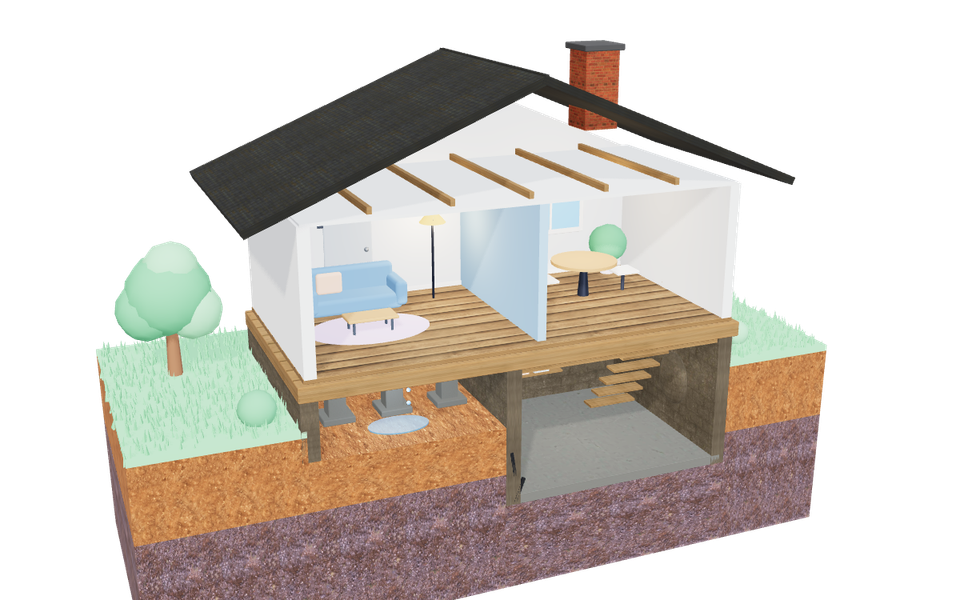
A crawl space is the low, open area between a home's first floor and the ground, usually 18 inches to 4 feet high. It matters because it holds your plumbing and the supports for your floors, and whatever happens to the air down there tends to rise into the house. Read more about what's actually under your floors.
Dehumidifier (pints per day)
A dehumidifier is a machine that pulls moisture out of the air, and its capacity is rated in pints per day. It matters because a unit that's too small runs constantly without keeping up. In a sealed crawl space, one sized correctly holds humidity below about 60%. Read more about a fully sealed crawl space.
Differential settlement
Differential settlement is when one part of a house sinks more than another. It matters because that uneven movement twists the frame, which causes cracks, sticking doors and sloping floors. A house settling evenly usually does much less harm than one settling at a single corner. Read more about foundation settling.
Drain tile
Drain tile is a perforated pipe buried in gravel that collects groundwater and carries it to a sump pit or away from the house. It matters because it relieves pressure at the base of a wall. It isn't actually tile anymore, though the old name has stuck around. Read more about keeping your basement dry.
Efflorescence
Efflorescence is a white, chalky crust left behind on concrete or block when water passes through and its salts dry on the surface. It matters because it's proof that water is moving through the wall, even if you've never actually seen it wet. Read more about why your crawl space gets wet.
Elevation survey
An elevation survey is a set of floor height readings taken throughout a home with a digital level. It matters because it shows exactly how far out of level each room is. Without one, any talk about lifting a house or how many piers you need is only a guess. Read more about have us measure it for free.
Encapsulation
Encapsulation is sealing a crawl space with a thick liner on the floor and walls, closed vents and usually a dehumidifier. It matters because it stops damp air and ground moisture from reaching your floors. It's more thorough than a plastic sheet laid on the dirt. Read more about crawl space encapsulation.
Epoxy injection
Epoxy injection is pumping a strong resin into a crack to bond the concrete back together. It matters because it restores strength to a stable structural crack. It won't help if the wall is still moving, since a new crack would simply form right next to the old one. Read more about foundation crack repair.
Expansive clay
Expansive clay is soil that swells when it's wet and shrinks when it's dry. It matters because that swing can lift and drop a foundation with the seasons. It's common across Texas and many parts of the South, and it's one of the biggest causes of foundation repair work. Read more about what causes foundation cracks.
Floor joist
A floor joist is one of the parallel horizontal boards that hold up a floor, usually resting on beams or walls. It matters because a cracked, notched or undersized joist is the most common reason a single spot in your floor starts to dip or feel bouncy. Read more about floor joist repair.
French drain
A French drain is a gravel-filled trench with a perforated pipe that collects water and moves it elsewhere. It matters because it gives water an easier path than your foundation. Inside a crawl space, it usually runs along the walls and empties into a sump pit. Read more about crawl space drainage.
Frost line
The frost line is how deep the ground freezes in a typical winter, and it varies by region. It matters because footings need to sit below it, or freezing soil can lift them. It's also why basements are so common in cold climates, since the digging was needed anyway. Read more about why basement walls lean in.
Girder (beam)
A girder is a large main beam that carries the floor joists and passes their load to posts or piers. It matters because when a girder sags, every joist resting on it goes with it. That's why one problem underneath can show up across a whole room. Read more about fixing the beams and posts under your floors.
Heave
Heave is when soil pushes a foundation upward, usually because wet clay is swelling or because of a leak. It matters because it can look a lot like settling but needs a different fix. Putting piers under a heaving slab is a common and expensive mistake. Read more about slab foundation repair.
Helical pier
A helical pier is a steel shaft with helix-shaped plates that screws into the soil to support a foundation. It matters because the torque needed to install it tells you how much load it can hold. It works especially well for lighter structures and tight spaces. Read more about helical piers.
Hydrostatic pressure
Hydrostatic pressure is the force of water-soaked soil pushing against a wall. It matters because it's why basements leak and walls bow. The wetter the soil gets, the harder it pushes, and good gutters and grading are the cheapest way to reduce it. Read more about bowing basement walls.
Karst
Karst is ground made of limestone or similar rock that slowly dissolves and leaves voids and sinkholes. It matters because it can cause sudden settling under a home, though that's rare. It shows up around Lexington, Nashville and Tallahassee, among other places. Read more about going deeper to stable soil.
Monolithic slab
A monolithic slab is a concrete foundation poured all at once, with the footings and the floor in a single piece. It matters because it's fast and common in warm climates, and it has no joint between floor and footing. Repairs usually work the same as with other slabs. Read more about how slab homes are built.
Pier and beam
Pier and beam is a foundation that holds a home above the ground on piers, with wood beams carrying the floor. It matters because the design gives easy access for repairs, and the home can be re-leveled from below. The wood does need to stay dry, though. Read more about pier and beam foundation.
Polyurethane injection
Polyurethane injection is pumping a flexible foam resin into a leaking crack, where it expands and seals out water. It matters because it stops leaks through the full thickness of a wall. It doesn't add structural strength, so it isn't a fix for a wall that's moving. Read more about sealing a crack the right way.
Pressed concrete pier
A pressed concrete pier is a stack of precast concrete cylinders pushed into the ground with a hydraulic jack until the soil resists. It matters because it's a fast, common way to support slab homes on clay. It usually won't go as deep as a steel pier. Read more about concrete piers.
Push pier
A push pier is a steel tube driven down in sections, using a home's own weight to push it toward deep, firm soil or rock. It matters because a gauge reads the load on each pier during the install, so you get a real number for what it can hold. Read more about steel push piers.
Shim
A shim is a small spacer set between a pier and the beam on top of it to hold the floor at the right height. It matters because old wood shims rot and crush, and that's a big reason floors drop in raised homes. Steel shims last much longer. Read more about pier and beam repair.
Sill plate
A sill plate is the piece of wood that sits directly on top of a foundation wall, where the house frame begins. It matters because it's close to masonry and moisture, so it's often the first thing to rot. A soft sill can let the wall above it settle. Read more about crawl space repair.
Sistering
Sistering is bolting a new joist tight against a weak one, so that they carry the load together. It matters because it's a cheaper way to strengthen a sagging floor than replacing old wood. It's usually done from a crawl space or basement, with your flooring left alone. Read more about sistering floor joists.
Slab-on-grade
Slab-on-grade means a concrete foundation poured directly on the ground, with no crawl space or basement under it. It matters because pipes run under the concrete, which makes leaks harder to reach. It's common across Texas, Florida and the Southwest, where footings don't need to go deep. Read more about slab foundation.
Sump pump
A sump pump is a pump in a pit that pushes collected water out and away from a home. It matters because it keeps drains working when gravity can't do the job. A battery backup is worth having, since the power often fails during the same storms that bring the water. Read more about crawl space sump pump.
Underpinning
Underpinning means adding support below an existing foundation, usually with piers that reach firmer soil. It matters when the original footing doesn't reach soil that can hold the house. It's different from leveling, which corrects a home's height using the supports that are already there. Read more about foundation underpinning.
Vapor barrier
A vapor barrier is a plastic sheet that slows ground moisture from rising into a crawl space. It matters because bare dirt can put a lot of water into the air. A thin, loose sheet isn't the same as sealing the space, which uses a thicker liner on the walls too. Read more about vented vs. sealed crawl spaces.
Wall anchor
A wall anchor is a steel rod that runs through a bowing wall and connects to a plate buried in stable soil out in the yard. It matters because it stops the movement and can pull a wall back slightly over time, as long as there's room to dig outside. Read more about stopping a wall that's moving.
Want to see how these fit together? Read how it works, learn about us or contact us.
Get your free inspection
We'll explain anything on your report in plain English, and you'll get your readings in writing.