The short answer
A crawl space is the low, open area between your first floor and the ground, usually 18 inches to 4 feet high. It lifts the house off the soil and gives crews access to pipes, ducts, wiring and the structure that holds up your floors. It should stay dry.
Key takeaways
- Crawl spaces usually run 18 inches to 4 feet high.
- Pipes, ducts and some dust are normal. Water and soft wood aren't.
- Don't go in if you see standing water and wiring.
- Humidity above 60% is your first warning number.
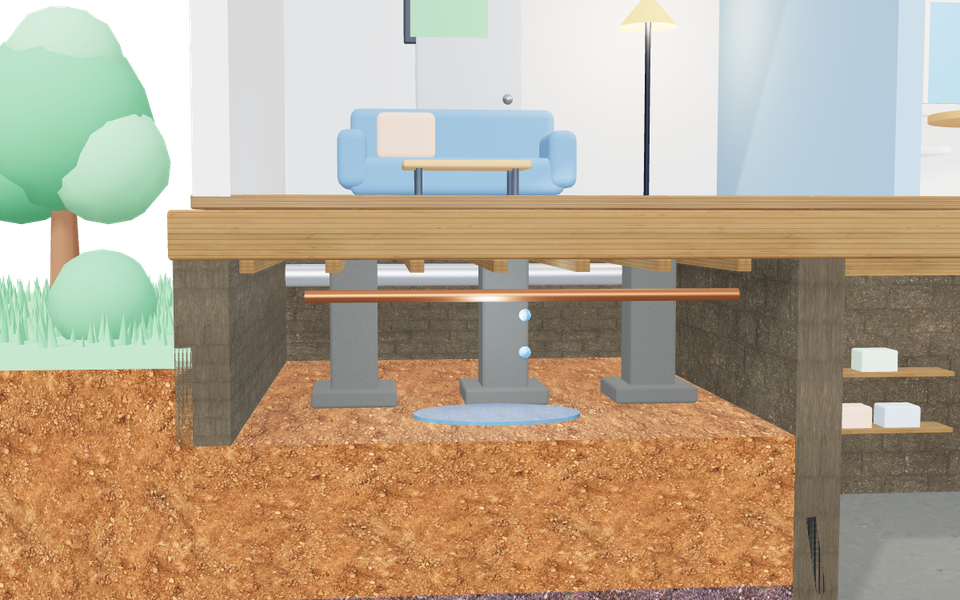
Most people live for years without ever looking under their house. Some folks spell it crawlspace, and most don't think about it at all until something smells wrong or a floor feels soft. We go under houses for a living, and here's what we'd want you to know.
What is a crawl space foundation?
A crawl space foundation holds your home off the ground on walls and supports, leaving a short open space below the floor. It's built in layers, starting from the soil up.
Perimeter walls of block, brick or poured concrete run around the outside. Inside, piers or posts hold up long beams called girders. Floor joists sit on top of those beams, and the subfloor sits on the joists.
If you've wondered what is a crawl space foundation doing that a slab doesn't, the answer is airflow and access. Your pipes and ducts are out in the open, which makes repairs easier. The trade-off is that you've got a dark, damp-prone area directly under your living space.
- Perimeter walls carry the outside of the house.
- Piers on footings hold up the middle.
- Beams and joists carry your floor.
- Pipes and ducts run through the open space.
- The space itself is usually 18 inches to 4 feet high.
Crawl space vs. basement vs. slab
The main difference is how far the house sits above or below the ground. Here's how the three common types compare, and you can read more about how slab homes are built and how raised homes are built.
| Factor | Crawl space | Basement | Slab |
|---|---|---|---|
| Height | 18 inches to 4 feet | Full height | None |
| Access to pipes | Good | Very good | Poor, under concrete |
| Common problems | Moisture, rot, sagging floors | Leaks, bowing walls | Cracks, plumbing leaks |
| Usable space | Limited storage | Yes | No |
| Build cost | Middle | Highest | Usually lowest |
Geography plays a big part too. Basements dominate the Midwest and Northeast, where footings already have to go below the frost line. Slabs are common in Texas and Florida. Crawl spaces are all over the Southeast and the Pacific Northwest.
What's normal to find down there
It's normal to find pipes, ducts, wires, a bit of dust and some old insulation. Most crawl spaces have about 18 inches of clearance, though newer homes often have more. Here's what we'd call perfectly ordinary:
- Copper or plastic supply lines and larger drain pipes
- HVAC ducts, and sometimes a furnace or water heater
- Electrical cable stapled to the joists
- A plastic sheet on the ground
- Some dirt, dust and a few spiders
Cold pipes can sweat a little on a humid day. A few small cracks in block may be old and harmless. Take a picture of anything you're not sure about, and compare it again in six months.
Warning signs in a crawl space
The warning signs are water, mold, soft wood, leaning posts and pests. Any of these can get expensive if they run for years.
Check for puddles, mud or water lines on the piers. Look for fuzzy growth on joists, or a musty smell that hits you when you open the door. Poke a beam with a screwdriver, and if it sinks in easily, you've got rot. Posts that lean or sit on loose blocks are a sign of trouble as well.
Structural problems are where fixing the beams and posts under your floors comes in. If water's the issue, start with water in your crawl space. Either way, they rarely fix themselves.
Basement crawl space setups
A basement crawl space setup is when a home has a partial basement that opens into a crawl space, often through a short wall. You'll see this a lot in older homes with additions, and in homes on sloped lots.
Humidity is the usual problem, since damp air moves straight from the crawl space into the basement. Musty smells in the basement often start in that open section. The fix is usually to treat the two areas as one system, so moisture control in one isn't undone by the other.
Insulation in the crawl space: what works
Insulation in the crawl space works best on the walls, not between the joists, in most climates. Fiberglass between joists tends to soak up moisture, sag and fall. We've pulled out a lot of it over the years, and it's usually black with mold on the side facing the dirt.
Foam board on the walls keeps working when it's damp, and it brings the crawl space inside your home's envelope. That's usually paired with a fully sealed crawl space. In a dry, well-vented space, faced batts held tight to the subfloor can still do the job.
How to check your crawl space safely
You can check your own crawl space safely with a few basic tools, but only if there's no water near electrical wiring. Standing water and wiring together are a reason to stay out and call a pro.
Grab a bright flashlight, an N95 mask, gloves and long sleeves. Open the crawl space door and look before you go in. Watch for animals, wet ground, hanging wires and obvious mold. Tell someone you're going in, stay out if there's a gas smell and don't touch anything you can't identify.
You can get a good view from the opening alone. Use your phone to take photos of the far corners, then zoom in afterward. If your space is too tight or too wet, skip it and let someone take a look. People who deal with foundation repair do this every day, and we know what to look for. Curious about repair prices? Here's what most repairs actually run.
Crawl space questions
Is it normal to have a crawl space?
Yes. Crawl spaces are one of the most common foundation types in the U.S., especially in the Southeast and in older homes. They became popular since they cost less than basements and give crews access to plumbing. Whether yours is healthy matters more than whether you have one.
How do I get into my crawl space?
Look for a small door or hatch. It's usually on an outside wall, in a closet floor or under a rug in a hallway. Some outside doors are behind shrubs or latticework. If you can't find one, check near the water heater or ask your home inspector.
Should a crawl space be dry?
Yes, it should stay dry year-round. Standing water is never normal, and humidity should stay below about 60%. A little dampness on the ground after a rare storm can happen, but anything that sticks around for days needs fixing before it reaches the wood above.
Can I store things in my crawl space?
You can, but be careful. Dampness ruins cardboard and fabric, and clutter gives pests a place to hide while blocking access for repairs. Use sealed plastic bins on a clean, dry floor. Never store anything against the water heater or furnace, and never store anything flammable down there.
What are crawl spaces for?
They lift the house off damp ground and give access to everything under the floor. Plumbing, ducts and wiring can be reached without breaking anything open. Builders also use them on sloped lots, since it's easier than leveling the ground for a slab.
How do I insulate a crawl space?
In most climates, insulate the walls and seal the space rather than stuffing fiberglass between the joists. Foam board on the walls holds up well when things get damp. In a vented crawl space, faced batts can work, but keep them dry and held up tight against the subfloor.
What is a crawl space in a house?
It's the short space under the first floor, between the framing and the dirt. You can't stand up in it, which is where the name comes from. It's not a room or a basement. It's there for structure and access, and most people only see it during repairs.
Run into a term you don't know? This may help: what all these terms mean.