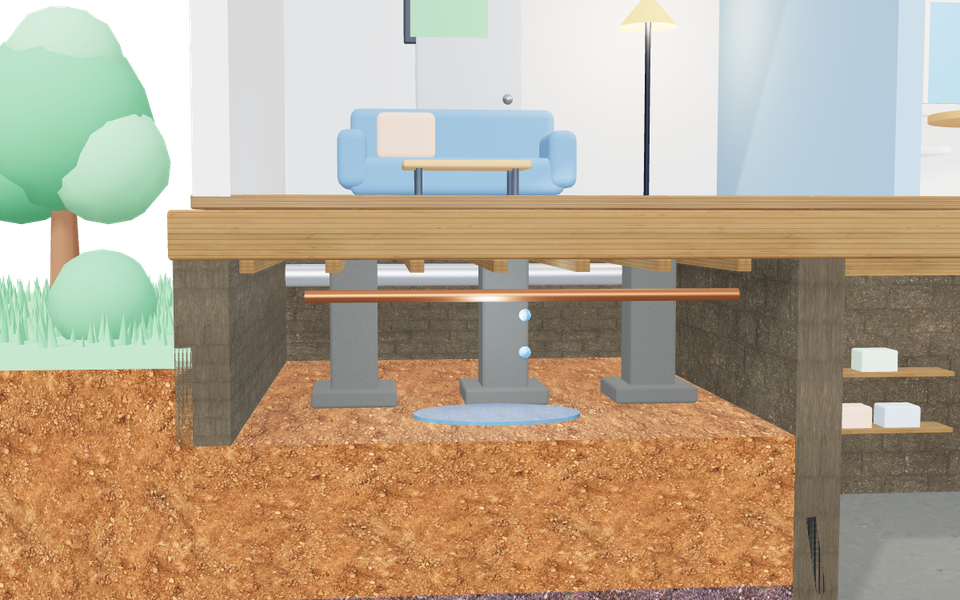
Nobody goes down there until something upstairs stops working. Then a door starts rubbing, the kitchen floor feels bouncy and someone finally pops the hatch. That's usually when you find out what's been going on for years.
Crawl space repair means fixing the structure that holds up your floors: the beams, posts and walls. We photograph everything we find, so you can see it for yourself without crawling through the dirt.
The short answer
Crawl space repair fixes the beams, posts, sill plates and walls that hold up your floors. Most jobs replace sunken or rotted supports with steel jacks on concrete footings and swap out damaged wood. Expect 1–3 days for a typical job, plus time to deal with whatever caused the damage.
What crawl space repair covers
Crawl space repair covers the load-bearing parts under your home. Here's the list we check on every visit:
- Girders and beams. These are the big timbers that carry the floor joists.
- Support posts. They hold up the beams. Many crawlspace supports we see are wood posts or stacked block.
- Sill plates. This is the wood sitting directly on top of the foundation wall.
- Foundation walls. Block or brick around the outside edge of the house.
- Insulation. Only when it has fallen or gotten soaked.
Damp air and standing water have their own pages. If the air's the issue, read about crawl space encapsulation. If it's puddles, see our crawl space drainage system work. We can do all of it in one visit, but they're separate fixes with separate prices.
Problems we find in crawl spaces every week
The same few problems show up under most homes we inspect. They rarely come alone, since water causes rot and rot causes sag.
Sinking or rotted support posts
We find wood posts sitting on loose block or plain dirt all the time. Soil settles, the post sinks and the beam above it follows. You feel that as a dip in the floor above it.
Cracked or bowing crawl space walls
Block walls can bend inward when wet soil pushes on them. Bowing crawl space walls usually show a horizontal or stair-step crack first. If you can lay a straightedge on the wall and see daylight behind it, that wall's moving.
Wood rot and termite damage on beams
Here's a test you can do yourself. Press a screwdriver into the wood. If a screwdriver sinks in with light pressure, that wood has lost its strength. Termite damage often looks fine from the outside and hollow underneath.
Fallen or soaked insulation
Fiberglass between joists gets heavy when it's wet, then sags and falls. Crawl space insulation repair means pulling that out and fixing the moisture that caused it. Putting new batts back into a damp space just starts the clock again.
How we fix it: crawl space support jacks and more
We pick the fix based on what's failing and why. Crawl space support jacks handle most sagging beams, but they're not the answer for every house.
Steel crawl space support jacks
Steel support jacks are adjustable posts that sit on concrete footings. They beat stacked block because they don't crumble, shift or wobble, and they can be adjusted later if the house moves. Every one gets its own footing, because a jack on bare dirt just sinks.
Sistering and beam replacement
If a joist is cracked or undersized, we bolt a new one alongside it, which is called sistering. Beams too far gone get replaced in sections. When the dip's in the floor itself, our work on fixing a floor that dips goes into more detail.
Wall anchors for bowing walls
Wall anchors tie a bowing wall to a plate buried in stable soil out in the yard. They stop the movement and can pull the wall back slightly over time. We use them when there's room outside to dig.
Crawl space support piers when the soil moves
If the whole perimeter is sinking, jacks inside won't fix it. Crawl space support piers go deep into firm soil and hold up the foundation walls. We cover that on our page about going deeper to stable soil.
| Method | When we use it | Typical time on site |
|---|---|---|
| Steel support jacks | Sagging beams, failed posts | 1–2 days |
| Sistering and beam replacement | Cracked, rotted or undersized wood | 1–3 days |
| Wall anchors | Bowing block walls, room to dig | 1–2 days |
| Support piers | Perimeter walls sinking | 2–4 days |
Why you want a crawl space specialist, not a handyman
A crawl space specialist looks at loads, heights and causes, while a handyman usually just looks at the broken part. A good handyman can swap a post. But if nobody asks why that post sank, you'll be doing it again in a few years.
Good crawl space services start with figuring out the cause: water, soil or undersized framing. Then the repair matches it. That's what you're paying for, and it's why we won't quote a job from a phone call.
What it usually runs
Steel support jacks usually run $300–$1,000 each, and beam replacement runs $1,500–$6,000. Those are typical ranges, and your exact price depends on what we find at the inspection. See how much foundation repair costs to compare it with other work.
Most of the price comes down to how many supports you need and how hard it is to get them in. A low crawl space takes longer, and that shows up on the bill. A free inspection gets you a written number for your house.
Crawl space repair questions
How do I know if my crawl space needs repair?
Bouncy floors, sticking doors and sloped rooms are the signs you'll notice upstairs. Down below, look for leaning posts, stacked blocks, soft wood and cracked walls. If a screwdriver sinks into a beam with light pressure, it needs attention. A flashlight and a phone camera can tell you a lot.
How long do steel support jacks last?
Steel jacks last for decades when they're on a proper footing and kept dry. The steel is rarely the weak spot. The footing under the jack and the moisture around it matter more, which is why we set each one on poured concrete and deal with any water.
Can you repair a crawl space foundation without lifting the house?
Often, yes. Repairing crawl space foundation parts usually means small, controlled lifts of a single beam, not raising the whole house. We jack just enough to take the load off, swap what's failed and set it down. Most homes never need a full lift.
Do you clean out the crawl space too?
Yes, when the repair calls for it. We haul out debris, fallen insulation and old wood we remove during the job, and bag it so it doesn't come through your home. A deep cleanup for mold or animal waste is scoped separately and written into your estimate.
Is a crawl space company near me better than a big national one?
Size matters less than what they do at your house. Whether you search for a crawl space company near me or call a big name, ask if they'll inspect in person, show you photos and put the plan in writing. If they won't, keep looking.
How do you install crawl space support jacks?
We dig out and pour a concrete footing, or set a precast one, directly under the beam. A steel jack goes on top and gets tightened slowly until it's carrying load. It usually takes a few turns over days or weeks, because wood needs time to move without cracking.
Can a crawl space foundation be repaired?
Yes, almost always. Cracked block can be sealed or reinforced, rotted framing can be replaced and sunken posts can be swapped for steel. Full rebuilds are rare. The bigger question is what caused the damage, because a repair won't last if the water or soil movement continues.
What does crawl space repair include?
It covers the structure under your floors: beams, posts, sill plates, joists and foundation walls. It can also cover fallen insulation. Moisture control and drainage are separate jobs, though many homes need both. Your written estimate lists each item so you can see what's being done and why.
Run into a term you don't know? This may help: what all these terms mean.