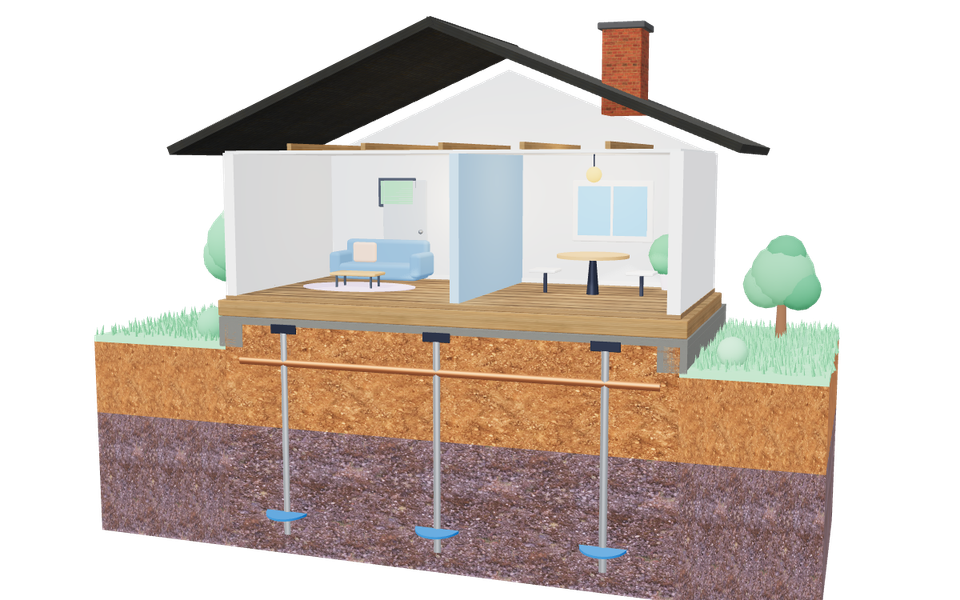
Most houses in Texas, Florida and the Southwest sit on a slab, also called slab-on-grade. That means the house rests on concrete poured right on the ground, with no crawl space below. When the soil moves, the slab has no choice but to go with it.
Slab foundation repair means stabilizing the ground under the concrete, not just covering cracks. We check what's moving and why, and then we lift only what needs lifting.
The short answer
Slab foundation repair stabilizes a cracked or sinking slab by supporting it on piers and lifting it back as close to level as is safe. Fine shrinkage cracks are normal and don't need it. Doors that stop latching and cracks with one side higher usually mean the slab has moved.
Is your slab sinking or heaving?
Your slab is either sinking, which we call settlement, or lifting, which we call heave. It matters a lot because they look similar and get opposite treatments.
Settlement happens when soil below shrinks or washes out, and it's common around the edges of a house in a dry summer. Heave happens when wet clay swells or a leak soaks the soil, and it often pushes up the middle. Put piers under a heaving slab and you've spent real money on the wrong problem.
- Settlement: soil under one edge shrinks or washes out.
- That edge drops, and the slab and walls crack.
- Heave: wet clay or a leak swells under the middle.
- The center pushes up, and the walls crack from the other side.
Cracks in a foundation slab: normal or not?
Some cracks in foundation slab concrete are normal, and most slabs have them. Thin shrinkage cracks show up in the first few years and don't mean much. If you've got one side higher than the other, or tile that's breaking in a straight line, that crack in concrete slab foundation work means movement.
Slab foundation crack repair on its own only works if the slab has stopped moving. Our guide on how to read a crack has pictures of each type.
Slab foundation repair methods we use
We pick slab foundation repair methods based on soil, house weight and how deep the firm layer is. Concrete slab foundation repair isn't one-size-fits-all, so here's how they compare:
| Method | Typical depth | When we use it |
|---|---|---|
| Pressed concrete piers | Until the soil resists | Many clay-soil slab homes |
| Steel push piers | Down to bedrock or dense soil | Heavier homes, deep firm layers |
| Helical piers | Set by torque | Lighter sections, tight access |
| Polyurethane foam | Just under the slab | Small voids, no major movement |
Pressed concrete piers
Concrete cylinders get pressed down one on top of another with a hydraulic jack, until the soil won't let them go further. It's a common choice in Texas clay, and the work moves quickly.
Steel push piers
Steel tubes get driven down using the weight of the house as the counterforce. They can go a lot deeper than concrete, and we can read the load on a gauge.
Helical piers
These are steel shafts with helix plates that screw into the soil. For lighter sections like an addition or a porch, screw-in steel piers are often the cleanest fix.
Polyurethane foam for small voids
Foam gets injected through small holes and fills gaps under the slab. It's useful for small voids, but it won't support a house that's actively sinking.
Why we check for plumbing leaks first
We check for leaks first because a leak under the slab can cause the whole problem. Water from a broken drain line can swell clay and lift the floor, or wash soil away and let it sink. Lift the slab without fixing that and it'll just happen again.
A plumbing test pressurizes your drain lines to see if they hold. If one fails, a plumber needs to find and fix the leak before we lift anything. We'd much rather find a leak first than do a much bigger repair twice.
Fixing a slab foundation: what the job looks like
Fixing a slab foundation usually takes 1–3 days, and you can usually stay home. Fixing slab foundation problems is mostly digging and patience. Here's what you'd see on each step of foundation slab repair:
- Digging. The crew opens small holes along the perimeter, or inside if the plan calls for it.
- Piers. Piers go in one at a time and get pressed down until they meet resistance.
- Lifting. Jacks raise the slab in small steps while someone watches a level.
- Backfill. Soil goes back in and gets tamped, and any floor openings get filled with concrete.
- Cleanup. We take the final readings and go over them with you.
What it usually runs
Slab work usually runs $4,000–$15,000, or about $1,000–$3,000 per pier. Those are typical ranges, and your exact price depends on what we find at the inspection. Here's more on slab foundation repair cost, including job sizes from one corner to the full perimeter.
Interior piers cost more because of the floor work, and a plumbing fix is separate. A free inspection gets you the pier plan and a written number.
Slab foundation repair questions
Can a slab foundation be lifted back to perfectly level?
Not always, and we won't promise it. Slabs aren't always poured dead level, and older homes can have decades of settled framing on top. We aim for as close as the house can safely go, usually within an inch or so across most of the floor.
How long does slab repair last?
Well-installed piers are meant to last for decades. Concrete and steel don't wear out in the ground very fast. What changes things is water, so if a leak or poor drainage continues, the soil can keep moving around the piers and in other areas of the house.
Will you need to break my floors?
Usually not. Most piers go in from outside along the perimeter. If the interior has sunk, we may need to open small sections of floor, about 2 feet square, and we'll mark those spots with you first. Tile and hardwood are the main things to plan around.
How many piers will my slab need?
It depends on how much of the house moved. A corner might take 4 to 6, one side 8 to 12 and a full perimeter 15 or more. Your elevation map decides this, and our page on steel push piers explains why spacing matters.
Can I stay home during the repair?
Yes, nearly always. Water and power usually stay on, though you may lose water briefly if a pipe's being fixed. Expect noise near the digging and some vibration during the lift. If there's interior work in a room, you'll want to keep pets and kids out of that area.
How do you repair a concrete slab foundation?
We test for leaks, install piers under the failing areas and lift the slab in small steps. Then we seal any cracks that are left and fill the holes. Small voids under the slab may get polyurethane foam. Any drainage problem gets fixed so the soil stays stable.
How do you fix a cracked slab foundation?
First find out if it's still moving. A stable crack gets sealed or injected and that's often all it needs. If one side has dropped, we support the low side with piers and lift it, then seal the crack. Sealing alone won't stop a slab that's moving.
What are the main slab foundation repair methods?
The main methods are pressed concrete piers, steel push piers, helical piers and polyurethane foam. Concrete piers suit many clay areas, push piers reach deep bedrock, helical piers work for lighter loads and foam fills small voids. Soil depth and your house weight decide which one fits.
Run into a term you don't know? This may help: our repair crews.