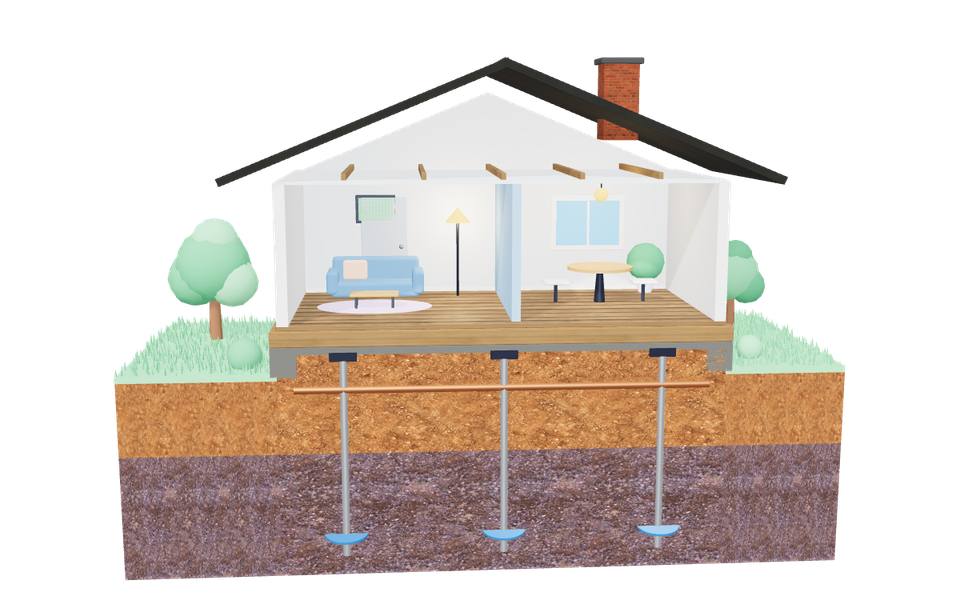
If your house keeps sinking, patching cracks won't change anything. You'll fill them, paint them and see them come back next summer. At some point you've got to deal with what's under the house.
Foundation piers move the weight of your house down through the soft soil to firm ground or rock. Once the house is on something that doesn't move, it should stop moving too.
The short answer
Foundation piers are steel or concrete columns installed under a house to move its weight down to firm soil or rock. They stop sinking and allow a controlled lift. They're worth it for real settlement, but they won't fix water problems or cosmetic cracks. Most jobs take 1–3 days.
How foundation piers work
How do foundation piers work? They bypass the soil that's giving you trouble. The top few feet of ground is called the active zone, and that's the layer that swells, shrinks or washes out. Piers go through it and reach load-bearing soil, meaning ground firm enough to hold the house without moving.
A bracket then connects each pier to your foundation. The house's weight goes down the pier instead of into the soft layer, and that's what stops the sinking.
- Soft soil lets one corner of the house sink.
- Steel sections are driven down through the moving clay.
- The pier reaches firm soil and takes the weight.
- The house lifts back, a little at a time.
Types of foundation piers we install
We install four types, and we pick based on your soil and house weight. Here's how they compare:
| Type | Depth | Speed | Best for | Limits |
|---|---|---|---|---|
| Steel push piers | Deep, to rock or dense soil | 1–3 days | Heavy homes | Needs house weight to drive them |
| Helical piers | Set by torque | 1–2 days | Lighter homes, porches, additions | Rock or cobbles can stop them |
| Pressed concrete piers | Until the soil resists | 1–3 days | Texas slab homes | Don't reach as deep |
| Drilled concrete piers | Designed depth | Slower, needs curing | New work, special cases | More equipment and time |
Steel push piers
Steel piers, also called push piers or hydraulic piers, are driven down in sections using a hydraulic ram and the weight of your house. The gauge tells us the load on each one. They work well when firm ground is deep.
Helical piers
These screw into the ground like a giant bolt and don't need the weight of the house to install. Our page on helical piers explains when we'd pick them.
Pressed concrete piers
These precast concrete piers get pressed down one cylinder at a time. People in Texas often call them slab piers, because they're so common under slab homes on clay. They're fast and usually cost less, but they won't reach as far as steel.
Drilled concrete piers
These are poured in holes drilled to a designed depth. They're used more for new construction and special cases, since the concrete has to cure and the equipment's bigger.
Foundation underpinning repair: when you need it
Foundation underpinning repair is what you need when the original foundation doesn't reach stable soil. Underpinning means adding support below what's already there, and pier foundation repair is the most common way to do it.
It's different from simple leveling. Leveling corrects the height using the supports you've got. Underpinning adds new supports because the old ones can't do the job. If your house keeps dropping after each level, that's your sign.
Are foundation piers a good repair?
Yes, for real settlement. They're among the most permanent fixes in this trade, and the result's measurable because you can read the load and depth. Here's the other side, though:
- They aren't cheap. The total adds up quickly if you need a lot of them.
- They don't fix cosmetic cracks. Drywall and brick touch-up comes after.
- They don't solve water problems. Poor drainage still needs its own fix.
- They aren't needed everywhere. If the house isn't moving, piers are wasted money.
Are foundation piers a good repair for a house that's only got a few shrinkage cracks? No, and we'd tell you so.
How we install foundation piers
We install foundation piers in six steps, and you get the numbers for each one. Every pier gets a documented load, so you've got proof instead of a promise.
- Inspect. We read the elevations and find where the house has dropped.
- Plan locations. You see how many piers, where they go and why.
- Excavate. We dig small holes next to the foundation.
- Install to target load. Each pier goes down until it hits the planned load, and we write it down.
- Lift. We raise the foundation in small steps while watching the readings.
- Backfill. Soil goes back, gets tamped and we clean up.
What it usually runs
Foundation piers usually run $1,000–$3,000 each. Those are typical ranges, and your exact price depends on what we find at the inspection. See foundation repair cost to see how that fits into whole-job totals.
The number of piers matters most, followed by depth and access. A free inspection gets you a written pier plan.
Foundation pier questions
How many piers does a house need?
It depends on how much of the house is moving and how heavy it is. One corner may take 4 to 6 piers, while a full perimeter can take 15 or more. Spacing is often 6 to 8 feet. Your written plan should show each location and the reason for it.
How long do foundation piers last?
They're built to last for decades, and many will likely outlast the house. Steel gets a protective coating and concrete does well below ground. Long-term results depend on the soil and on water around the home, so keep your downspouts and grading in good shape.
Will piers close my existing cracks?
Some will close partly when the foundation lifts, but not all of them. Piers stop movement, they don't patch anything. Expect some drywall and brick touch-up after the lift, and plan on it as a separate cost. We'll show you which cracks we think will close.
Do I need a permit for foundation piers?
It depends on your city. Some building departments require one for any structural repair, and others don't. We handle permits where they're required, and we'll tell you up front if your job needs one. Ask to see it, because a real permit means someone else is checking the work.
Push piers or helical piers: which is better?
Push piers suit heavier homes, because they use the home's weight to reach deep soil or rock. Helical piers suit lighter loads and don't need that weight, so they work for porches and additions. Soil and weight decide which one's right, so we check both first.
What is a pier foundation?
A pier foundation holds a building up on columns that transfer its weight to firm soil, instead of spreading it out on the surface. The term covers both new construction and repairs. In a repair, piers are added under an existing foundation to stop it from sinking.
What is a concrete pier?
A concrete pier is a column of concrete under a foundation that carries weight down to firmer soil. In repair work they're usually precast cylinders pressed in one on top of another. Drilled concrete piers are poured in place and are more common on new homes.
How deep do foundation piers go?
They go as deep as it takes to reach soil that holds the load, and that varies by location. Some reach firm soil at 10 to 20 feet, while others go much deeper. We record the depth and load for each one, so you'll have the real numbers afterward.
Run into a term you don't know? This may help: foundation repair glossary.