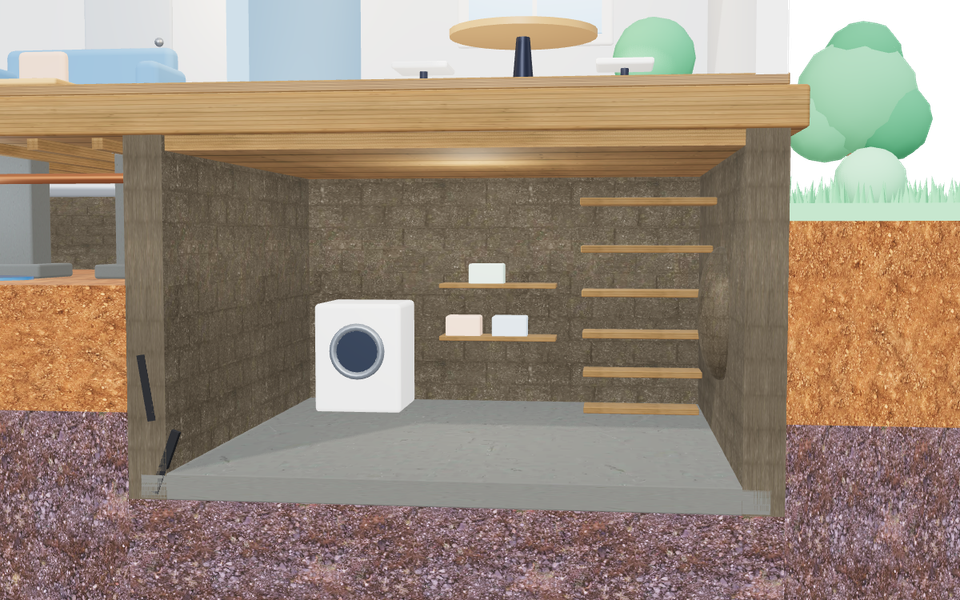
You go down to switch the laundry and notice a line in the wall that you've never seen before. Is it new? Was it always there? You stand there with the basket, trying to remember.
Basement wall repair depends on whether that wall is just cracked or actually moving. Those are very different jobs, so we measure before we say anything. It's the difference between a few hundred dollars and a few thousand.
The short answer
Basement wall repair stops cracked or bowing walls from moving further. Stable cracks get epoxy or polyurethane injection. Walls bowing under 2 inches usually get carbon fiber or anchors, and walls past that may need straightening or rebuilding. A horizontal crack is the one you shouldn't put off having measured.
Basement crack repair: what each crack is telling you
Basement crack repair starts with reading the crack, because the pattern tells you what's pushing on it. A crack in basement wall concrete isn't automatically a problem.
Vertical cracks
These usually come from concrete shrinking as it cured, and nearly every poured basement has at least one. They're rarely structural. If a vertical crack leaks, basement wall crack repair usually means a simple injection.
Horizontal crack in a basement wall
A horizontal crack is usually soil pressure bending the wall inward. It often runs along the middle third of the wall height, or just below grade. This is the crack we take most seriously, because a horizontal crack in basement wall block means the wall's being pushed.
Stair-step cracks in block walls
These follow the mortar joints up and across the wall. They suggest movement, either from settling or from soil pushing near a corner. Check whether the blocks have shifted out of line with each other.
How to tell if a basement wall is moving
You can check for movement yourself in about 10 minutes. Stretch a string tight from one end of the wall to the other, a few inches off the surface, then measure the gap in the middle. A 4-foot level held against the wall also works for short sections.
As a rough guide, walls bowing less than 2 inches can often be stabilized where they are. Past that, you may need straightening or rebuilding. Write the number down with the date, then measure again next month. Our guide on a bowed basement wall goes further on how to track it.
How we repair basement walls
We pick the method by how far the wall has moved and what room we've got to work. Here's the short version:
| Method | When we use it | The work |
|---|---|---|
| Crack injection | Stable cracks | Half a day, from inside |
| Carbon fiber straps | Mild bowing | About a day, from inside |
| Wall anchors | Moderate bowing, room in the yard | 1–2 days, small holes outside |
| Steel I-beam braces | Can't dig outside | 1–2 days, from inside |
| Excavate and rebuild | Last resort | Several days, full excavation |
Crack injection
Epoxy bonds a stable crack, and polyurethane seals a leaking one. Either way, it's quick and doesn't touch your yard. It won't hold back a wall that's still moving.
Carbon fiber straps
These flat straps bond to the wall with epoxy and hold it in place. They're strong and sit nearly flush, so they're easy to frame over. Bowed basement wall repair with carbon fiber works best when the wall hasn't moved far.
Wall anchors
An anchor is a steel rod that runs through the wall to a plate buried in stable soil in the yard. Tightening it over time can bring the wall back a little. They're a good choice for bowed foundation wall repair when there's room to dig.
Steel I-beam braces
When a driveway or a neighbor's house sits right up against the wall, we can't dig. Steel braces run floor to joist on the inside, and they can be tightened as well. They stick out into the room, which is the main trade-off.
Excavate and rebuild
If a wall has moved too far or has started to fail, we dig outside, take down the bad section and rebuild it. It's the most expensive fix and the least common. We'd rather catch it long before that.
Basement foundation repair starts outside
Basement foundation repair usually starts outside, since most wall pressure comes from water in the soil. Downspouts that dump next to the wall and soil that slopes toward the house soak the backfill. Expansive clay swells when it's wet, and freeze-thaw cycles add more pressure in cold climates.
We'll look at all of that before we touch the wall. Basement foundation crack repair doesn't hold if the same water keeps pushing on the same spot. Often the cheapest thing you'll do is extend a downspout 10 feet.
If that's what you're dealing with, here's our page on basement leak repair.
What it usually runs
Crack injection usually runs $250–$800 per crack, and reinforcing a wall runs $4,000–$12,000. Those are typical ranges, and your exact price depends on what we find at the inspection. Here's more on how much foundation repair costs for other kinds of work.
Wall length, how far it's moved and whether the wall's finished all change the number. A free inspection measures the wall and gets you a written price.
Basement wall repair questions
How fast does a bowing basement wall get worse?
Usually slowly, over years, but it can jump after a wet spring or a hard freeze. There's no safe schedule, since it depends on your soil and drainage. Measure it monthly and write down the numbers. If it moves more than 1/4 inch in a season, call someone soon.
Can you straighten a bowed wall?
Partly, sometimes. Basement wall bowing repair is mostly about stopping movement first. Wall anchors can pull a wall back a little over time, as the soil allows, and only with careful tightening. Walls that have moved a lot may need excavating outside to bring them back.
Carbon fiber or wall anchors: which is better?
It depends on how far the wall has moved. Carbon fiber is clean and low-profile but it's best for walls bowing less than about 2 inches. Anchors handle more and allow some straightening, but they need room in the yard. We'll measure before we recommend either one.
Do you need to dig up my yard for wall repair?
Only for some methods. Carbon fiber and steel braces go on from inside, with no digging at all. Wall anchors need small holes in the yard, usually one per anchor, and we patch them when we're done. A full excavation is the last resort and it's rare.
Should I buy a house with a bowing basement wall?
You can, as long as you know the number first. Get it measured and priced before your contingency runs out, then negotiate from there. A slight bow with a clear repair plan is a fair deal. A wall that's leaning badly with no price attached isn't.
How do you repair basement wall cracks?
Stable cracks get injected with epoxy or polyurethane from the inside. If the wall is moving, we stabilize it first with carbon fiber, anchors or braces, then seal the crack. Sealing first would just hide the warning sign while the wall keeps moving behind the patch.
Can crumbling basement walls be repaired?
Often, yes, if the crumbling is on the surface. Patching and parging can restore old brick, block or fieldstone. Deep crumbling needs the failed section rebuilt. Either way, water is usually what started it, so the drainage has to be fixed or the damage will come back.
Is a horizontal crack in a basement wall serious?
Yes, treat it as serious until it's been measured. It usually means soil pressure is bending the wall inward. It doesn't mean the wall's about to fall, but it won't fix itself. Get it measured soon, and keep heavy equipment and new soil away from that side.
Run into a term you don't know? This may help: foundation repair glossary.