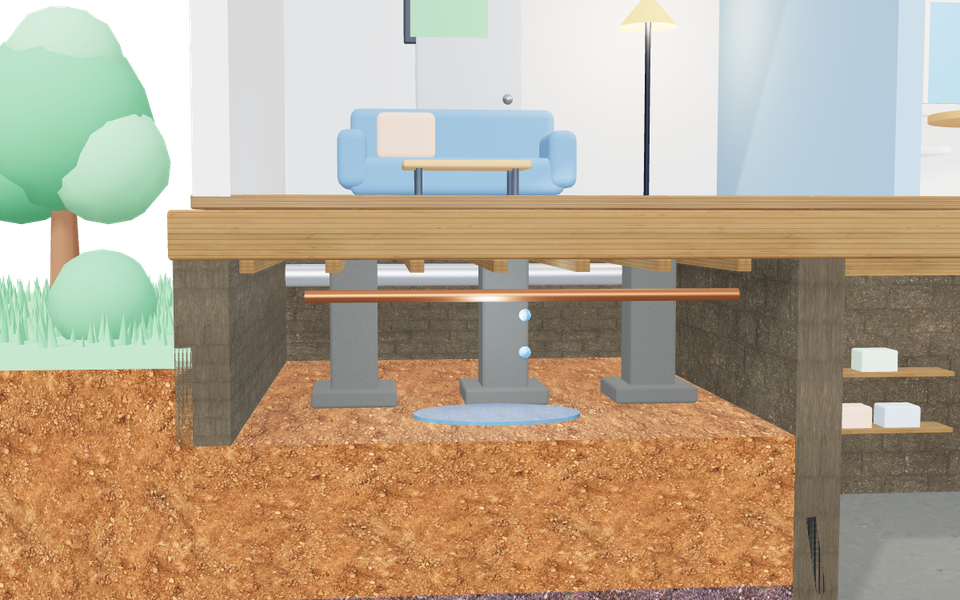
It rains hard on Tuesday. By Wednesday there's a puddle under the house, the dirt has turned to mud and the plastic sheeting is floating in spots. You may not know any of this until a plumber or a home inspector comes back up with wet knees.
A dehumidifier can't fix liquid water. Crawl space waterproofing collects that water and moves it out, so the wood above it can dry and stay dry. We'll trace where it's getting in before we suggest anything.
The short answer
Crawl space waterproofing is a drainage system that catches water before it pools and pumps it away from your house. It's usually an interior drain, a sump pump and a discharge line. It's the right fix when you see standing water, but damp air alone needs sealing instead.
When crawl space waterproofing is the right fix
Crawl space waterproofing is the right fix when you've got liquid water, not just damp air. Humidity is a moisture problem in the air, and you control it by sealing. Liquid water has to be drained. Our guide on water in your crawl space covers how to tell the two apart.
Look for the signs real water leaves behind. You'll see standing water after storms, level lines on piers and block, puddles on top of the liner, or efflorescence on the walls. Efflorescence is the white, chalky crust that salts leave when water passes through masonry.
How a crawl space drainage system works
Crawl space drainage works by giving water an easier path than your floor. It runs from the wall into a drain, along the drain to a pit, and out through a pipe. Most systems are that simple.
- Water gets in at the base of the wall and pools.
- A gravel-lined drain along the wall catches it.
- The drain carries it to a sump pit.
- The pump sends it out and away from your home.
Interior perimeter drain (crawl space french drain)
A crawl space french drain is a shallow trench along the inside of the foundation walls. It holds perforated pipe wrapped in fabric and surrounded by gravel. Water takes the easy way into the pipe instead of spreading across the floor.
Crawl space sump pump and discharge line
The drain empties into a pit with a pump inside. When the water rises, a float switch turns the pump on and it pushes the water out through a discharge line. We add a battery backup where outages are common, because storms and outages tend to show up together.
Gutters, downspouts and grading outside
Sometimes the fix starts outside and costs almost nothing. Extending your downspouts 10 feet from the house can stop a surprising amount of water. So can correcting a flower bed that slopes toward the foundation. We'll tell you if that's all you need, even though it means a smaller job for us.
Do you need drainage, sealing or both?
Drainage moves water and sealing controls humidity, so the answer depends on what's going wrong. In humid parts of the country, they usually go together. Picture a Georgia summer: you can pump out every drop and still have air at 75% humidity coming through the vents.
If that sounds like your house, drainage comes first and sealing your crawl space for good comes right after. Do it backward and you've got water trapped under a new liner. If your crawl space is damp but never wet, you can often skip the drains entirely.
Our crawl space waterproofing process
Our crawl space waterproofing process has five steps, and it's the same whether the space is 600 sq. ft. or 3,000. Most waterproofing crawl spaces projects are done in a day or two.
- Inspect. Right after a rain is ideal, because the water shows us where it's coming from. We'll also map any wet wood.
- Plan. You get a written plan showing the drain path, the pit location and where the water exits.
- Trench and drain. We dig along the inside of the walls and set the pipe in gravel. Crawlspace drainage systems only work with the right slope, so we check it as we go.
- Sump and discharge. The pit, pump and line go in, along with a battery backup if you want one.
- Water test. We run water through it and watch it leave. You're welcome to come look.
Have a partial basement? Basement crawl space waterproofing has to handle both areas, so we often tie them into the same pit. That saves you from running two pumps.
We also offer crawl space waterproofing services as an add-on when a house already has a working liner. In that case we lift the plastic carefully, run the drain and seal it back down.
How to waterproof a crawl space: what you can do yourself
You can do a lot of how to waterproof a crawl space from outside the house, and it's worth trying first. These jobs are cheap and they sometimes solve the whole problem.
What you can do this weekend:
- Clean your gutters, then watch them during a rain
- Extend downspouts away from the house
- Slope the soil away from the foundation, about 6 inches over the first 10 feet
- Fix a dripping hose bib or a leaking irrigation line
What we'd leave to a contractor: digging interior trenches, setting a sump pit and running discharge lines. You're working on your stomach in a tight space, near wiring and sewer lines, and a drain with the wrong slope just moves the puddle. If your wood's already soft, you'll want fixing the beams and posts under your floors on the list too.
What it usually runs
Interior drainage usually runs $600–$1,800. A sump pump adds $1,000–$2,500 installed. Those are typical ranges, and your exact price depends on what we find at the inspection. Here's a closer look at the cost of waterproofing a crawl space, including jobs that need sealing as well.
Length of the perimeter matters most, followed by how tight the access is. A free inspection gets you real measurements and a written number.
Crawl space waterproofing questions
Do I need a sump pump in my crawl space?
You need one if water collects and can't drain away by gravity. Most flat lots and low crawl spaces fall into that group. If your lot slopes well, a drain can sometimes run out to daylight without a pump, and we'll tell you if yours can do that.
How long does installation take?
Most interior drain and sump installs take 1–2 days. Long perimeters, tight access or rocky soil can add time. You can stay home the whole time, since the crew works under the house and comes in through the access door or a vent opening.
What happens if I ignore water in my crawl space?
Wood rots, mold spreads, termites move in and floors start to give. It rarely happens overnight, but joists that stay wet for a few seasons get soft. A drain is usually far cheaper than replacing the beams and subfloor above it later on.
Will it work during a power outage?
Only if it has a battery backup. A standard sump pump stops when the power goes out, which is often when storms are worst. We recommend a battery backup anywhere outages are common, and we'll size it to run through a typical storm.
Do you need to dig up my yard?
Not for interior drains. Those go inside the crawl space, so your yard and plantings stay put. Exterior drains do mean digging along the foundation, so we only suggest them when the water can't be handled from inside. The discharge line may need a small trench.
Do I need a French drain in my crawl space?
You probably do if water comes in along the walls during storms. A French drain is a gravel-filled trench with perforated pipe that collects water before it spreads. If the water only comes from a bad gutter or a plumbing leak, fix that first and you may not need one.
How long does a crawl space drainage system last?
The pipe and gravel usually last for decades if silt stays out. Pumps are the wear item and often need replacing after several years, depending on how hard they work. Check the pump yearly by pouring water in the pit and watching it kick on.
Can you waterproof a crawl space from the outside?
Yes, but it costs more. Exterior work means digging down along the foundation, then adding a membrane and drain. It makes sense when walls are failing or when you can't get inside. For most homes, interior drainage solves the same problem with far less digging.
Run into a term you don't know? This may help: foundation terms explained.