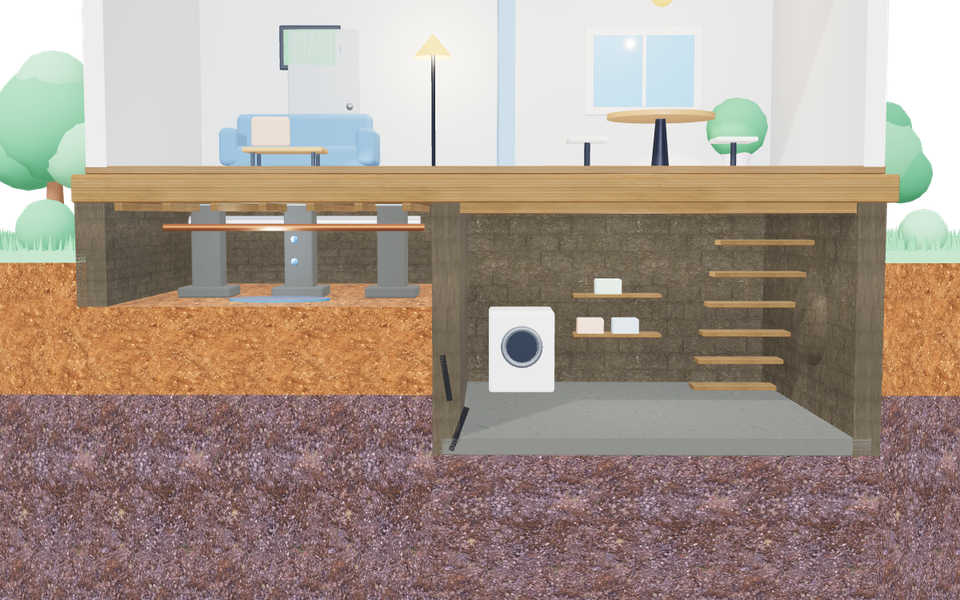
It starts with the smell. Then you notice a dark line on the carpet along the wall, the day after a good rain. You move a box and the bottom of it is soft.
Basement leak repair starts with finding out where the water's getting in. A leak at the floor joint and a leak through a crack have different fixes, and the wrong one's just wasted money. We trace it before we quote it.
The short answer
Basement leak repair finds where water gets in and stops it there. Cracks get polyurethane injection, and floor-joint leaks usually need interior drain tile and a sump pump. Whole-wall seepage may need an exterior membrane. Fix your gutters and grading first, because that sometimes solves the leak for far less money.
Why basement leaks happen
Basement leaks happen because the soil around your home fills with water, and that water wants in. Concrete and block look solid but they're full of small paths. Here are the four we see most.
Hydrostatic pressure
Hydrostatic pressure is the force of water-soaked soil pushing against a wall. The wetter the soil, the harder it pushes. That pressure is why a basement can stay dry for years and then leak in one heavy spring.
- Rain soaks the soil around your basement.
- The water level climbs, and pressure on the wall grows.
- Water finds the cove joint, where the floor meets the wall.
- It spreads across the floor as a puddle.
The cove joint
The cove joint is where the floor meets the wall. They're poured separately, so there's a seam all the way around your basement. If you've got a thin line of water at the bottom of a wall, this is likely it.
Cracks, tie rods and pipe openings
Poured walls have small holes left by the tie rods that held the forms together. Those, along with shrinkage cracks and pipe openings, are common entry points. A small rust stain below a dot on the wall usually marks a tie rod leak.
Window wells and gutters
A window well without a working drain turns into a bucket against your wall. Gutters that overflow at a corner do the same thing, and they're easy to spot in a storm.
Water seeping through a basement wall? Read the pattern
When there's water seeping through basement wall concrete, it leaves a pattern, and the pattern points to the cause. Here's how we read it. A leaking basement wall that's damp all over needs one more check, which you can do yourself: tape a square of aluminum foil to the wall for 24 hours. Moisture on the room side of the foil means condensation. Moisture on the wall side means water coming through.
| What you see | Likely cause |
|---|---|
| Water along the floor-wall joint | Pressure pushing through the cove joint |
| Water following a line up the wall | A crack or a water leak in basement wall concrete |
| The whole wall damp | Condensation or seepage, so try the foil test |
| Water below a window | Window well or a failed seal |
How we fix basement leaks
We start with the cheapest fix that actually solves it, and go from there. Basement water leak repair usually includes one or two of these four.
Crack injection
Polyurethane foams into a leaking crack and stops the water all the way through the wall. It's quick, it's done from inside and it's often all you need if a single crack is the only leak.
Interior drain tile and sump pump
We open a narrow strip of floor along the wall, lay perforated pipe in gravel and run it to a sump pump. This takes the pressure off at the floor joint. It's usually the most reliable basement wall leak repair for water coming in low.
Exterior waterproofing membrane
Here we dig down along the outside of the foundation, clean the wall and add a membrane and drain. It stops water before it reaches the wall. It's also the most expensive and disruptive option.
Gutters, grading and window wells
This part gets skipped too often. Cleaning gutters, extending downspouts and fixing a low spot near the wall can reduce the water by a lot. We'll point these out whether we get the job or not.
| Basement leakage solutions | Effectiveness | The work | Best for |
|---|---|---|---|
| Crack injection | High for that crack | Half a day | One or two leaking cracks |
| Drain tile and sump | High for low leaks | 1–3 days | Floor joint and low wall seepage |
| Exterior membrane | Highest | 3–5 days, digging | Full wall seepage, major water |
| Gutters and grading | Varies, often high | Hours | Every home, first |
Can you fix a basement leak yourself?
Yes, you can fix basement leak causes outside the house, and you should try that first. Clean your gutters, extend your downspouts and build up low spots so the soil slopes away. Sealing a thin, dry crack with a kit from the store is fine too.
What won't work is waterproofing paint on an active leak, because it can't hold back water under pressure. Leaky basement repair from there means drains or injection, which is where we'd come in.
Flooded basement repair: the first 24 hours
Flooded basement repair starts with staying safe. Here's what to do in the first day, in this order:
- Don't step in the water if the power's still on down there. Water and live outlets can kill you.
- Turn off the power at the main panel, but only if you can reach it without walking through water.
- Take photos and video for your insurance before you move anything.
- Pump out the water or call someone who can.
- Get things dry within 24–48 hours using fans and dehumidifiers. After that, mold starts to grow.
FEMA has more flood safety guidance if it was a big flood. Once it's dry, call us and we'll figure out why it happened.
What it usually runs
Interior drains usually run $2,000–$7,000, and exterior waterproofing runs $5,000–$15,000. Injection runs $250–$800 per crack. Those are typical ranges, and your exact price depends on what we find at the inspection. Here's more on foundation repair cost in general.
If a wall is moving as well as leaking, see stopping a wall that's moving too. A free inspection covers both, or you can book a no-pressure inspection right now.
Basement leak repair questions
Why does my basement leak only when it rains hard?
Hard rain saturates the soil around your walls faster than it can drain, and that builds pressure. Light rain soaks in and goes away. Check your gutters and downspouts during the next storm. If water pours out next to the house, that's often half your problem.
Is a sump pump enough on its own?
Usually not. A sump pump only moves water that reaches the pit. Without drain tile around the edge of the floor, water coming through the wall or cove joint just sits there. A pit alone helps with a high water table but rarely solves wall seepage.
Does waterproofing paint stop leaks?
Not active ones. Paint can slow dampness from a little vapor, but it can't hold back water under pressure, and it peels once it's pushed from behind. It also hides the evidence from anyone trying to find the leak. We'd skip it if water's actually coming through.
Does homeowners insurance cover basement leaks?
It depends on where the water came from. A burst pipe is often covered, but groundwater seeping through a wall usually isn't. Sewer backup and flood damage normally require separate coverage. Call your agent and take photos before you clean anything up, so there's a record.
How long does the work take?
Crack injection usually takes half a day. Interior drain tile and a sump pump take 1–3 days, depending on the length of the walls. Exterior waterproofing takes longest, often 3–5 days, because of the digging. We'll give you the schedule in your written estimate.
How do you fix basement walls that leak?
Start with the source. Stable cracks get polyurethane injection, while water at the floor joint usually needs drain tile and a sump pump. If the whole wall is seeping, you may need an exterior membrane. Fix the gutters and grading outside first, since that's the cheapest part.
Can you fix a leaking basement wall from the inside?
Yes, in most cases. Crack injection pushes resin all the way through the wall from inside, and interior drains catch what's left. Those methods don't stop water from reaching the wall, they manage it. Stopping it completely takes exterior work, which costs a lot more.
Why does water seep through my basement wall when it rains?
Wet soil pushes water through the small gaps in your wall. Rain raises the moisture around the foundation, and pressure builds until water finds a crack, a tie rod hole or the floor joint. Poor gutters and soil that slopes toward the house make it much worse.
Run into a term you don't know? This may help: foundation repair glossary.