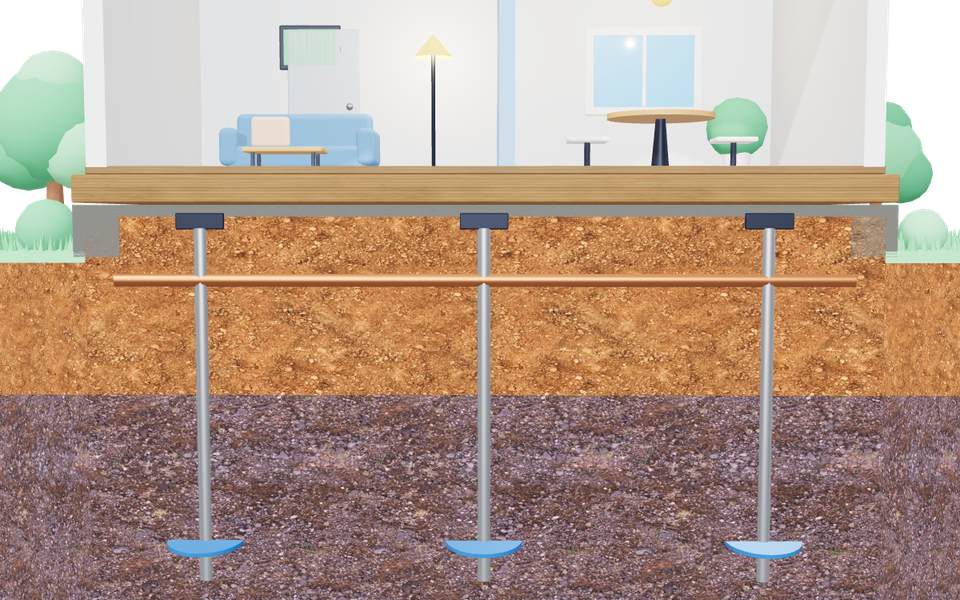
A helical pier is a steel shaft with round plates on it, and it screws into the ground like a giant wood screw. That's really all it is. The clever part is what the machine tells you while it's going in.
Helical piers are our preferred choice when the structure is light or access is tough. They go in fast, they don't need to cure and they come with a number that shows how much they'll hold.
The short answer
Helical piers are galvanized steel shafts with helix plates that screw into stable soil to support a foundation. The installing torque tells us how much load each one can carry. They're great for lighter homes, porches and additions, with no curing time and a typical install of 1–2 days.
What are helical piers?
What are helical piers, exactly? They're galvanized steel shafts with one or more helix plates near the tip, turned into the ground by a hydraulic head. As they bite into firmer soil, the machine has to work harder.
That resistance is called torque, and it's the whole reason we like them. There's a well-known link between torque and how much load a pier can carry. So we're not guessing how strong the soil is, because the gauge shows us.
Each pier's torque gets written down as it goes in. That log is yours to keep, and it's the proof of what's holding up your house. Few other repairs give you a number like that.
- We dig a small hole at the foundation.
- The steel shaft screws down through soft soil.
- Torque climbs as the plates bite into firm soil.
- A bracket ties the pier to your foundation.
When we use helical piers (and when we don't)
We use helical piers when the load is light or access is tight, and we skip them when another option's a better fit.
Good fits:
- Lighter homes, and sections that aren't heavy
- Porches and additions pulling away from the house
- Deep, soft soils
- Tight spaces where big equipment can't go
Not as good:
- Rocky fill or cobbles, which can stop the plates
- Heavy structures, where a push pier can use the weight to reach rock more directly
If that second case sounds like your house, foundation piers goes over the other options. We'll check your soil and tell you which fits.
One more thing to check is what's above the ground. Helical piers can go in close to a wall with fairly small equipment, so they often work where a big rig couldn't fit, like between houses or behind a fence.
Helical pier installation, step by step
Helical pier installation takes five steps, and most jobs wrap up within a day or two. Helical piers for foundation repair need only a small hole and compact equipment, so your yard usually takes less of a hit.
- Locate. We mark every pier from the elevation map and load plan.
- Dig a small hole. It's usually just a few feet wide.
- Screw in and log torque. The pier turns into the soil while we record the reading.
- Bracket and transfer the load. A steel bracket ties it to your foundation and takes the weight.
- Backfill. We fill the hole and tamp the soil.
Helical piers vs. concrete piers
Helical piers aren't always better than concrete, but they do win on speed and proof. Are helical piers better than concrete? It depends on the soil and the load, and here's how they compare:
| Factor | Helical piers | Pressed concrete piers |
|---|---|---|
| Speed | Fast, often same day | Fast |
| Curing | None | None for precast, days for poured |
| Capacity check | Torque reading on each one | Press-down resistance |
| Noise | Low to moderate | Moderate |
| Weather | Can go in cold or wet weather | Poured concrete is limited by weather |
| Best for | Lighter loads, tight spaces | Heavier slab homes on clay |
For many Texas slab homes, concrete makes sense and it's what we'd recommend. For a porch on soft soil, helical piers usually win.
How long do helical piers last?
Helical piers are designed to last for decades, thanks to galvanized steel. Corrosion depends on the soil, since wet, salty or acidic ground is tougher on steel than neutral clay is. We check conditions before we recommend them, and a heavier coating or thicker shaft can make up for it.
A helical piers foundation job also depends on water and soil around the home. Keep your drainage in good shape, and the piers should be the last thing you worry about.
What it usually runs
Helical piers usually run $1,000–$3,000 each. Those are typical ranges, and your exact price depends on what we find at the inspection. Here's more on what most repairs actually run, including how totals add up across a whole house.
Depth and how many you need are what move the price. A free inspection gets you a written plan with both.
Helical pier questions
How deep do helical piers go?
They go as deep as it takes to reach the target torque, which is often 10 to 25 feet in residential work. Soft soils can take them deeper. We don't decide the depth ahead of time, because the torque reading tells us when the soil will carry the load.
How many helical piers do I need?
It depends on the load and how much of the foundation moved. A porch may need 2 to 4, and a side of a house might need 6 to 10. Spacing is usually around 6 feet. Your written plan lists each location and the load it'll carry.
Do helical piers work in clay soil?
Yes, they work well in most clay. The plates just need to reach below the layer that swells and shrinks, into firmer soil. Very stiff clay or rocky fill can slow them down or stop them early, which is one reason we check the soil first.
Can helical piers lift my house?
Yes, for lighter structures and within reason. They can hold and raise many homes, porches and additions, as long as they're rated for the load. On a heavy house with a deep firm layer, push piers may be a better match, and we'll tell you if so.
How long does helical pier installation take?
Most jobs take 1–2 days. Each pier often goes in within an hour or two once we're set up. Because there's no curing time, the load can transfer the same day, and you can usually fill the holes and clean up by the time we leave.
How do helical piers work?
They screw into the soil like a big bolt, and the helix plates bear on the ground around them. As resistance grows, so does the torque on the installing machine. That reading tells us the capacity, and a bracket then transfers the house's weight to the pier.
Are helical piers good?
Yes, they're a good fix when they match the job. They install fast, need no curing and come with a measured capacity. They're less suited for very heavy homes or rocky ground. Ask to see the torque logs, since that's the proof you got what you paid for.
What are titan or adjustable helical piers?
It's a loose term for helical systems with adjustable or specialized parts. Some brackets can be raised or lowered later to fine-tune the height. Others use different shaft types. Don't shop by the name. Ask about rated capacity, torque records and the corrosion protection they use.
Run into a term you don't know? This may help: what all these terms mean.