The short answer
Foundation settling is normal in a home's first few years, as long as it's slight and even. Cracks that keep growing, doors that stop closing and sloping floors point to differential settlement, which means one part of the house is sinking faster than the rest. That kind usually needs repair.
Key takeaways
- A little settling in the first few years is normal.
- Uneven settling, called differential settlement, is what causes damage.
- Movement in an older home usually has a different cause.
- Measuring floors is the only way to know for sure.
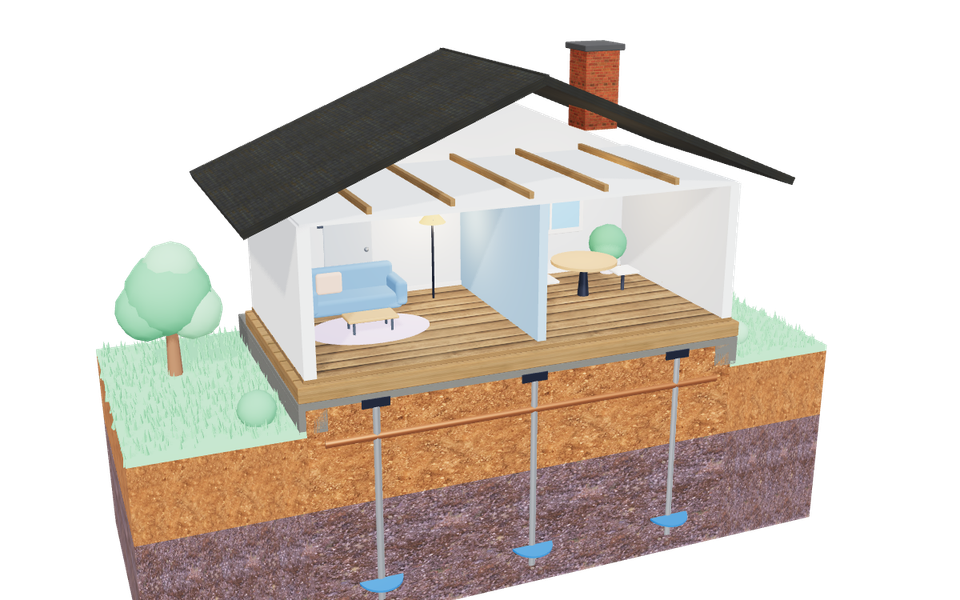
"Oh, that's just the house settling." You've probably heard that one from a relative, a neighbor or the person who sold you the place. Sometimes it's true. Sometimes it's what people say about a real problem they don't want to deal with. Here's how to tell.
What is foundation settling?
Foundation settling is what happens when the soil under a house compresses under its weight. All houses do it to some degree. What matters is whether the whole house goes down together or just one part of it.
Uniform settling means the house drops evenly, usually a small amount. It doesn't do much harm, because everything moves as one piece. Differential settling means one end drops more than the other, and that's when the frame starts to twist. That twist is what cracks your walls and jams your doors.
- Even settling: the house drops as one piece and stays square.
- Differential settlement: one end drops faster than the other.
- The frame twists, and cracks open in the walls.
How long does a house settle?
How long does a house settle? Most settling takes place in the first few years after it's built, as soil compresses and framing dries. After that, it usually slows to almost nothing.
So if your 30-year-old house has just started moving, that's not normal settling anymore. Something has changed. It could be a new leak, a long drought, a big tree or a change in drainage. House foundation settling at that age has a cause, and you can usually find it.
New homes have their own rules. Many builders offer a structural warranty, and the first few years are when you'd want to use it. Take dated photos of any cracks as they appear, even small ones. If something does grow, you've got a record of when it started. That can matter a lot if you end up talking to the builder or a lawyer.
Signs of a sinking foundation
The signs of a sinking foundation come in clusters, usually in one part of the house. These point to differential settlement:
- Cracks in drywall at door and window corners
- Stair-step cracks in brick or block outside
- Doors and windows that stick, or latch only some of the time
- Floors you can feel slope
- Gaps between trim and walls
- A chimney pulling away from the house
- A porch separating from the wall
One of these on its own might mean nothing. House settling can make a door stick for a season, and that's all. Three of them in the same corner of the house is a different story. The way to know is to have someone measure it, which is why we put an elevation map in every visit.
Common foundation problems that look like settling
Several common foundation problems look like settling but have different causes, and the fix is different too. Here are the ones we see most:
- Plumbing leaks under a slab. Water washes soil away, or swells it.
- Heave. Wet clay pushes a slab up, and that looks a lot like the edges sinking.
- Rot in pier and beam homes. Shims crush and beams soften, so floors drop even though the soil hasn't moved.
This is why foundation issues house owners see can't be diagnosed by looking at a crack alone. Put piers under a heaving slab and you've wasted your money. Replacing rotted wood doesn't help if the piers are sinking.
A good way to sort these out is to look at the pattern of movement in your readings. Settling usually shows a low corner or side. Heave usually shows a high middle. A plumbing leak often lines up with a bathroom or kitchen wall. Rotted wood in a raised home tends to drop one room while the piers around it stay put.
How foundation settlement repair works
Foundation settlement repair works by stopping the movement and then correcting what you can. Most jobs involve some mix of these three things.
Piers move the weight of your house to firmer soil, and that's the main fix for true settlement. Our page on foundation piers explains how. Next comes lifting, which brings the house back as close to level as it'll safely go. That's what house leveling covers.
Then comes water control. Gutters, grading and drainage keep the soil from changing again. Skip it and you've only solved part of the problem. A sinking foundation almost always has water somewhere in the story. To see how this looks on a real budget, see foundation repair cost.
When to walk away from foundation issues
When to walk away from foundation issues depends on the numbers, your timeline and how much the seller will work with you. If you're buying a house, here's how we think about it.
Usually negotiable: shrinkage cracks, a small slope that's stable and a repair with a written price. Get an estimate before your option period or contingency ends, then ask the seller for a credit or a repair.
Worth walking away from: major movement with no written estimate, a seller who won't allow an inspection, a repair record with no paperwork or a price that goes beyond your budget for fixing it. If the numbers don't work, don't talk yourself into them.
Selling? A report from the team that fixes foundations can help you get out in front of it before a buyer's inspector finds it first. It's often the difference between negotiating on your terms and negotiating on theirs.
Foundation settling questions
Is house settling covered by insurance?
Usually not. Most homeowners policies exclude settling, shrinking and normal earth movement. A covered event like a burst pipe that washed out the soil may be different. Read your policy, and if you file, take dated photos. Your agent can tell you what's covered.
Can settling stop on its own?
Yes, sometimes it does. Normal early settling slows and stops after a few years. Movement from a fixable cause, like a downspout dumping at one corner, can also stop once that's corrected. If it keeps going after that, the soil itself may be the problem, and it won't stop on its own.
Is a settling foundation dangerous?
Rarely right away. Most settlement moves slowly and gives you years of warning. It gets more serious if you've got large cracks, doors that won't open or walls that are visibly out of plumb. A blocked exit or a gas line under stress should be handled right away.
How do I know if my foundation is sinking?
Look for a pattern: cracks that grow, sticking doors, sloped floors and gaps at the trim, all in one part of the house. A marble test helps, but only elevation readings confirm it. Track what you see with dates and photos, so you've got a record of changes.
How do you fix a sinking floor?
First find out why it's sinking. A local dip usually means joists or a failed post, which get fixed from below. A whole section sinking usually means the foundation, which takes piers or leveling. Fixing it from on top with compound doesn't do anything about what's causing it.
How do you prevent foundation settlement?
Mostly by controlling water. Extend downspouts away from the house, keep soil sloped away and fix leaks quickly. In clay areas, keep the moisture around the foundation steady in long droughts, and watch large trees close to the house. You can't change the soil, but you can reduce how much it moves.
Can a building collapse from foundation issues?
It's very rare for a house to collapse from settling alone. Homes usually show years of warnings first. The more serious risks are bowing walls that keep moving and heavily rotted supports. If you see a wall bulging fast or a beam cracking, get out of that area and call for help.
Run into a term you don't know? This may help: foundation terms explained.